
Aluminum Gravity Die Casting vs. Low-Pressure Die Casting: Key Differences and Application Guidance
Aluminum casting technology is widely applied in automotive, aerospace, mechanical manufacturing, and household appliance industries. Among mainstream molding processes, gravity die casting (GDC) and low-pressure die casting (LPDC) are two essential permanent mold casting methods. Both adopt reusable metal molds to shape molten aluminum alloy, yet they differ fundamentally in working principles, molding characteristics, product performance, production costs, and applicable scenarios. A clear understanding of their distinctions is critical for manufacturers to optimize process selection, balance product quality and production efficiency, and control manufacturing costs.
1. Core Working Principles
The essential gap between the two processes lies in the driving force and filling mode of molten aluminum.
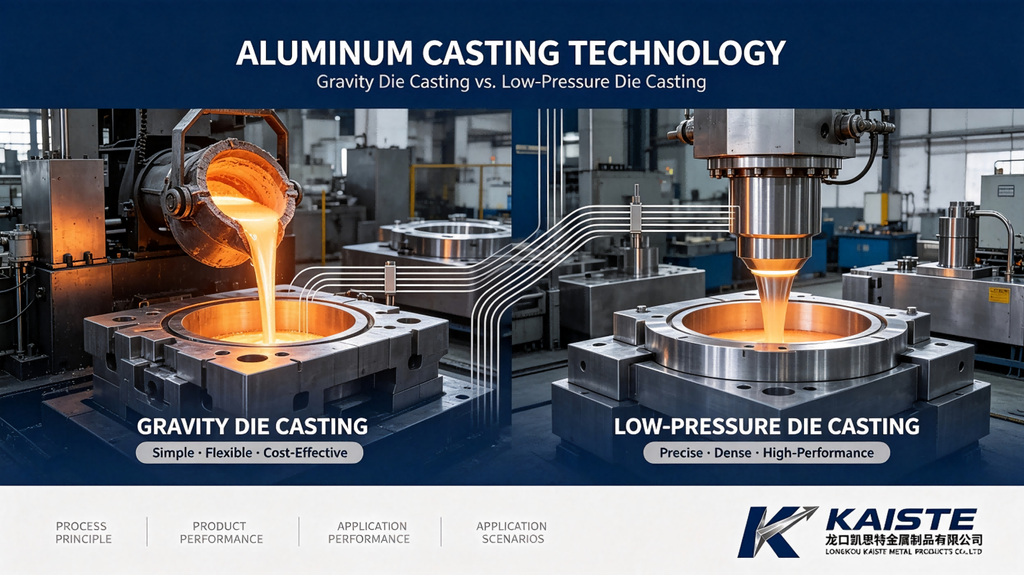
Gravity die casting, also known as permanent mold gravity casting, relies entirely on natural gravitational force as the power source. Molten aluminum alloy is manually or mechanically poured into the mold cavity from the top of the mold. The liquid metal flows downwards and fills the cavity under gravity alone, with no external pressure assistance during the entire filling and solidification process. This is a traditional, simple casting process with minimal technical thresholds and equipment requirements.
Low-pressure die casting is a precision casting process based on controllable external pressure. It places the sealed crucible filled with molten aluminum in a pressure tank, and applies stable low air pressure (typically 0.05 MPa, or 0.5 bar) to the liquid metal surface. Driven by uniform low pressure, the molten aluminum rises slowly through the riser tube and fills the mold cavity gently from bottom to top. The sustained pressure is maintained throughout the solidification stage to compensate for volume shrinkage during alloy crystallization, effectively avoiding shrinkage cavities and porosity defects.
2. Molding Process and Quality Characteristics
The different filling methods directly lead to significant differences in internal and surface quality of castings.
Gravity casting features top-down rapid filling. The fast flow of molten metal easily causes turbulence, splashing, and air entrapment inside the cavity, resulting in common defects such as porosity, oxidation inclusions, and uneven wall density. The solidification sequence is uncontrollable, making it difficult to eliminate localized shrinkage defects. In terms of precision, gravity castings have relatively low dimensional accuracy and rough surface finish, requiring more subsequent machining and polishing processes. Additionally, the uneven internal structure limits the stability of mechanical properties.
Low-pressure casting’s bottom-up, low-turbulence filling mode eliminates air entrapment and metal splashing, greatly reducing oxidation inclusions and pore defects. The porosity rate of LPDC castings can be controlled below 0.5%, achieving excellent internal compactness. Moreover, the directional solidification formed by bottom-up filling and top-down cooling matches the pressure feeding effect perfectly, thoroughly solving shrinkage problems. This process produces castings with high dimensional accuracy, smooth surface quality, and uniform internal structure, laying a solid foundation for stable mechanical performance.
3. Mechanical Performance Differences
The structural compactness and defect rate directly determine the mechanical properties of aluminum castings, with obvious gaps between the two processes.
Gravity cast aluminum parts have ordinary mechanical indicators, with tensile strength ranging from 240 MPa to 280 MPa, yield strength from 160 MPa to 200 MPa, and elongation at 5% to 8%. Affected by internal pores and inclusions, the parts have poor fatigue resistance and low structural stability. They cannot withstand high-load and long-term cyclic stress, and are only suitable for non-safety structural parts with low performance requirements. Besides, gravity castings have limited heat treatment compatibility; high-temperature heat treatment tends to cause blistering and scrapping, restricting performance improvement.
Low-pressure castings deliver significantly upgraded mechanical properties: tensile strength reaches 280 MPa to 320 MPa, yield strength 200 MPa to 240 MPa, and elongation 8% to 12%. The dense internal structure greatly enhances fatigue resistance and structural rigidity. More importantly, LPDC castings fully support T6 standard heat treatment without blistering or deformation, further optimizing strength and toughness. These superior properties make them qualified for safety-critical and high-load structural components.
4. Production Efficiency and Cost Analysis
In terms of production economy, each process has its unique advantages and applicable production scales.
Gravity casting boasts low equipment investment and simple operation procedures. The mold structure is uncomplicated, with low manufacturing and maintenance costs, and the production preparation cycle is short. Although its single-piece production cycle is slightly longer, it has strong flexibility for small-batch and customized production of large and simple-structured parts. The overall production cost is low, making it highly cost-effective for low-precision, medium and small-batch production scenarios.
Low-pressure casting requires professional low-pressure casting equipment and sealed crucible systems, with higher upfront equipment and mold investment. The production process requires precise pressure and temperature control, leading to slightly higher technical and labor costs. However, its low defect rate greatly reduces scrap loss and rework costs. The process supports automated continuous production with stable batch consistency, showing prominent cost advantages in large-batch, high-precision product mass production.
5. Applicable Scenarios
Based on the above differences in quality, performance, and cost, the two processes have clear application boundaries.
Gravity die casting is ideal for low-precision, simple-structured, and non-safety-critical aluminum parts, such as ordinary mechanical housings, simple structural brackets, large thick-walled decorative parts, and general household appliance accessories. It is the preferred process for medium and small-batch production with low requirements for internal quality and mechanical properties.
Low-pressure die casting is targeted at high-precision, high-strength, safety-critical structural parts. It is widely used in automotive core components (wheel hubs, engine brackets, chassis structural parts), aerospace lightweight parts, pressure-tight hydraulic and pneumatic housings, and mechanical parts requiring high fatigue resistance and air tightness. It is especially suitable for mass production of thin-walled, complex-structured aluminum castings with strict quality standards.
6. Conclusion
In summary, gravity die casting and low-pressure die casting have their own strengths and applicable fields. Gravity casting is a cost-effective, flexible process suitable for low-demand, small-to-medium batch aluminum casting production. Low-pressure casting, as a high-precision and high-performance process, excels in producing high-quality, high-reliability castings for critical industrial scenarios despite higher initial investment.
In actual industrial production, manufacturers should select the optimal casting process based on product structural complexity, performance indicators, batch scale, and cost budget. Reasonable process selection can effectively balance product quality, production efficiency, and economic benefits, maximizing the market competitiveness of aluminum casting products.