
Why Impregnate Aluminum Die Castings? What Are the Benefits?
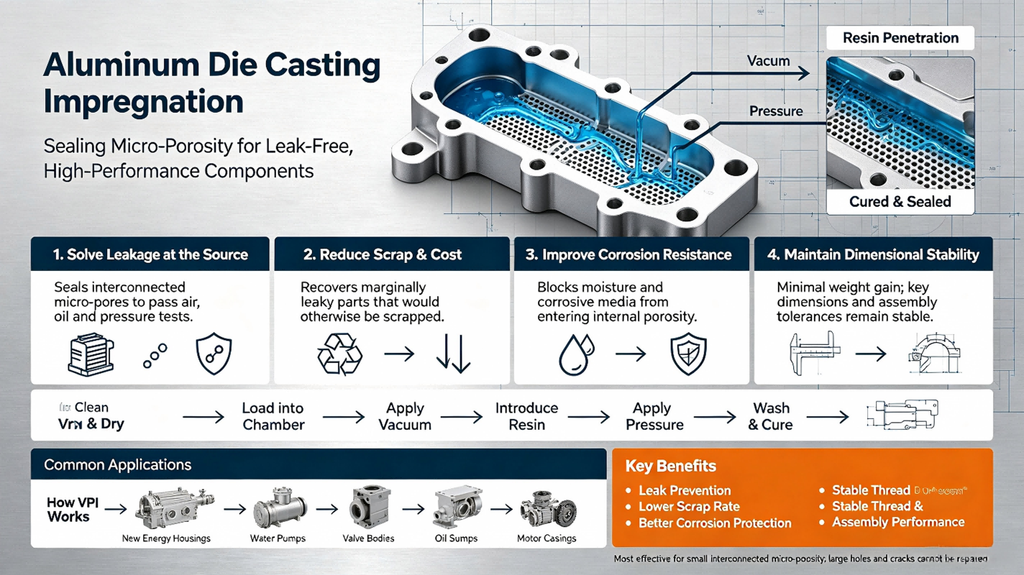
Aluminum Die casting inherently produces pores, porosity and microvoids. When microvoids are interconnected, parts will leak oil, water or gas under hydraulic/pneumatic pressure. Impregnation uses vacuum and pressure to inject liquid resin into internal microvoids. After curing, the interconnected pores are permanently sealed without changing the part’s dimensions. This process is widely used for pressure-sealing components such as new energy housings, water pumps, valve bodies, oil sumps and motor casings.
Main Benefits
- Leakage Prevention (Most Critical)
Seals interconnected microvoids to pass hydrostatic, air and oil pressure tests, eliminating leakage of oil, coolant and gas. It works well for threaded holes and thin-wall shells, even for microvoids exposed after machining.
⚠️ Note: Only effective for small interconnected porosity. Large holes and cracks cannot be repaired by impregnation and the parts must still be scrapped.
- Lower Scrap Rate & Cost Savings
Many die castings fail leak testing after machining and would otherwise be discarded. Impregnation salvages these slightly leaking parts, cutting raw material and machining losses. It is a mature defect remediation method in the die casting industry. - Improved Corrosion & Moisture Resistance
Resin fills microvoids and blocks moisture and corrosive media from penetrating inward, reducing internal pitting corrosion. For subsequent anodizing, painting or electroplating, it prevents blisters and pinholes caused by outgassing from pores, raising surface treatment yield. - Enhanced Compactness & Thread Performance
Filling internal porosity improves material compactness to a certain extent. Sealed microvoids inside threads boost tensile strength and sealing stability. Weight gain is minimal (usually less than 1~2%) and key dimensions remain unchanged, so assembly tolerances are unaffected. - Supports Lightweight Die Casting Design
Allows thinner wall designs without extra material added just for leak resistance, enabling lightweight solutions. It is commonly applied to new energy electric control housings.
Brief Process Principle (VPI: Vacuum Pressure Impregnation)
Cleaning, degreasing and drying → Air inside microvoids is extracted under vacuum in the tank → Impregnating resin is introduced → Pressure forces resin into microvoids → Excess resin on the surface is washed away → Hot water/heating curing permanently hardens resin inside pores.
Methyl methacrylate organic impregnants are mainstream today, with temperature resistance around -50~200℃ and stable curing. Old sodium silicate (water glass) impregnants have poor durability and are rarely used in automotive and new energy industries.
Parts That Usually Do Not Require Impregnation
Non-pressure-bearing structural or cosmetic castings with no sealing requirements generally skip impregnation.