

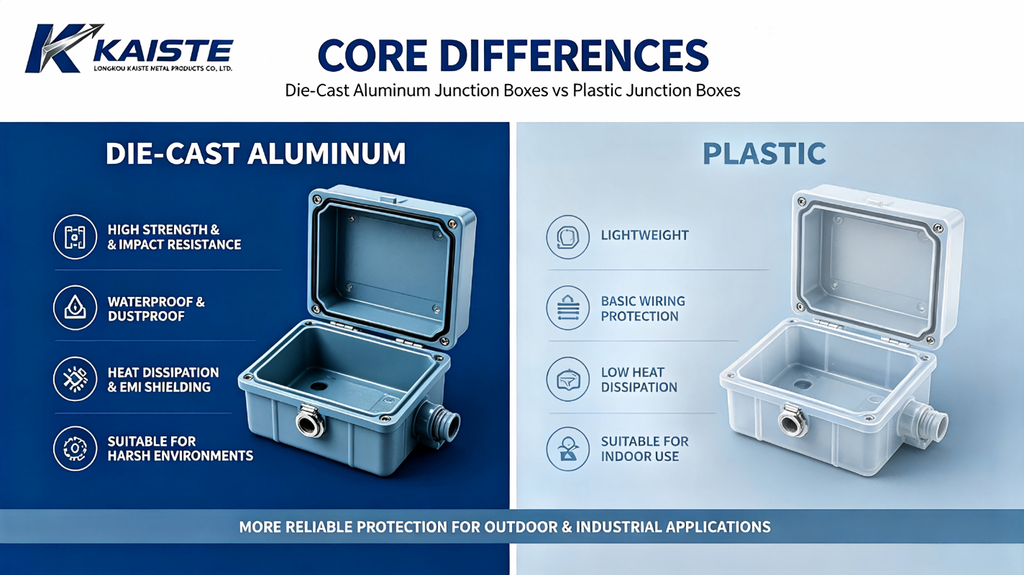
Core Differences Between Die-cast Aluminum Junction Boxes and Plastic Junction Boxes
- Structural Strength Die-cast aluminum boxes are one-piece molded with high rigidity and impact resistance, no deformation under harsh conditions. Plastic boxes are prone to warping, cracking and aging under temperature changes and UV exposure.
- Weather Resistance & Lifespan Aluminum enclosures feature wide temperature tolerance (-40℃~85℃), UV & corrosion resistance, with a service life of over 10 years. Plastic enclosures degrade quickly outdoors, only lasting 2–3 years.
- Protection Performance Aluminum boxes maintain stable IP65/IP67 waterproof & dustproof ratings permanently. Plastic enclosures easily lose tight sealing due to shell deformation, only offering basic IP44/IP54 protection.
- Heat Dissipation & EMI Shielding Aluminum alloy provides excellent heat dissipation and electromagnetic shielding to ensure stable circuit operation. Plastic boxes have poor heat dissipation and no anti-interference performance.
- Application Scenarios Aluminum junction boxes are ideal for outdoor, industrial, coastal, chemical and mining harsh environments. Plastic boxes are only suitable for indoor dry civilian low-voltage wiring scenarios.