
Differences in Density and Porosity of Aluminum Alloy Products Produced by Die Casting and Gravity Casting Processes
Aluminum alloy die casting and gravity casting are two prevalent manufacturing processes for aluminum components, featuring fundamental differences in molding mechanisms, product compactness, porosity rate and overall mechanical performance. This article elaborates on their disparities in product density and porosity, as well as the respective advantages, disadvantages and application characteristics of the two processes.
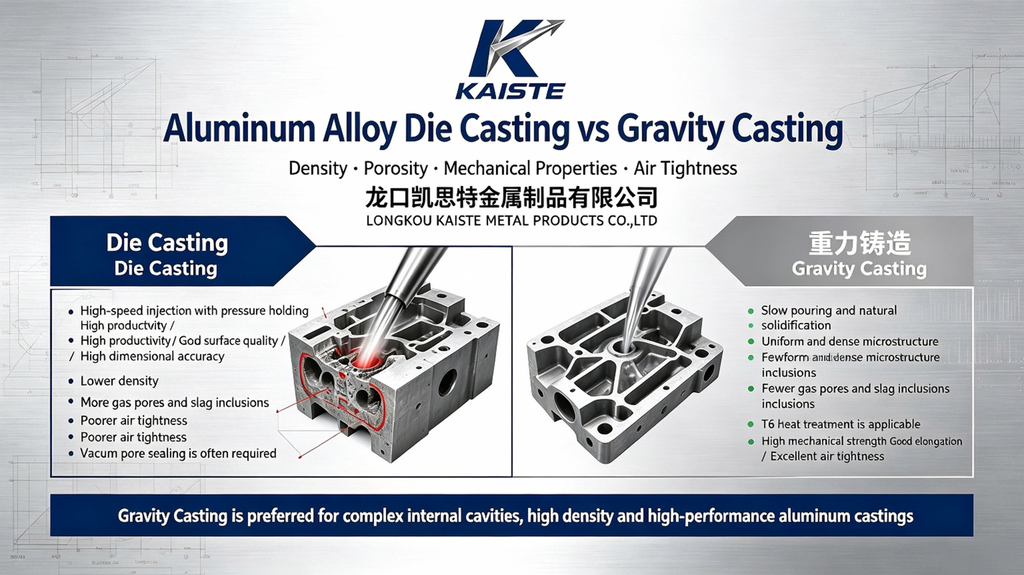
Aluminum alloy die casting is a process in which molten aluminum is injected into die molds at a high speed, then solidified through pressure holding and cooling. It possesses remarkable strengths of high production efficiency, low manufacturing cost, superior surface quality and high dimensional accuracy of finished parts. Nevertheless, the process has obvious drawbacks. It requires high mold investment, and die-cast parts suffer from low structural density. Their internal microstructures are prone to shrinkage cavities and porosity defects. A large number of internal gas holes and slag inclusions are generated during the high-speed injection of molten aluminum, as the fluid entrains substantial ambient air.
Such inherent defects lead to poor mechanical properties of die-cast aluminum products. These components cannot be strengthened via T6 heat treatment because their abundant internal pores will cause structural failure during the heat treatment process, resulting in low mechanical strength. Additionally, die-cast aluminum alloys contain a high iron content, which is inversely correlated with elongation rate — the higher the iron content, the lower the ductility of the parts. Owing to the porous internal structure, die-cast aluminum products also deliver poor air tightness. In most cases, a vacuum pore sealing process is required to fill and seal internal shrinkage defects and gas holes. Moreover, the die casting process is incapable of manufacturing parts with complex inner cavities, such as teapots with narrow openings and large inner volumes.
In contrast, the gravity casting process operates by slowly pouring molten aluminum into casting molds and allowing the liquid metal to solidify naturally under gravity, with its pros and cons completely opposite to those of die casting. Gravity casting enables the fabrication of parts with complex internal structures and delivers uniformly dense internal microstructures. With well-designed molds, aluminum castings produced by this process can achieve virtually pore-free and slag-free internal quality.
Gravity-cast aluminum parts are eligible for T6 heat treatment strengthening, which endows the final products with high mechanical strength, excellent elongation and superior air tightness. Since internal casting defects are invisible to the naked eye, X-ray inspection with X-ray machines is universally adopted to detect and visualize the internal structural conditions of aluminum castings accurately, so as to verify the compactness and defect status of gravity-cast and die-cast products.