
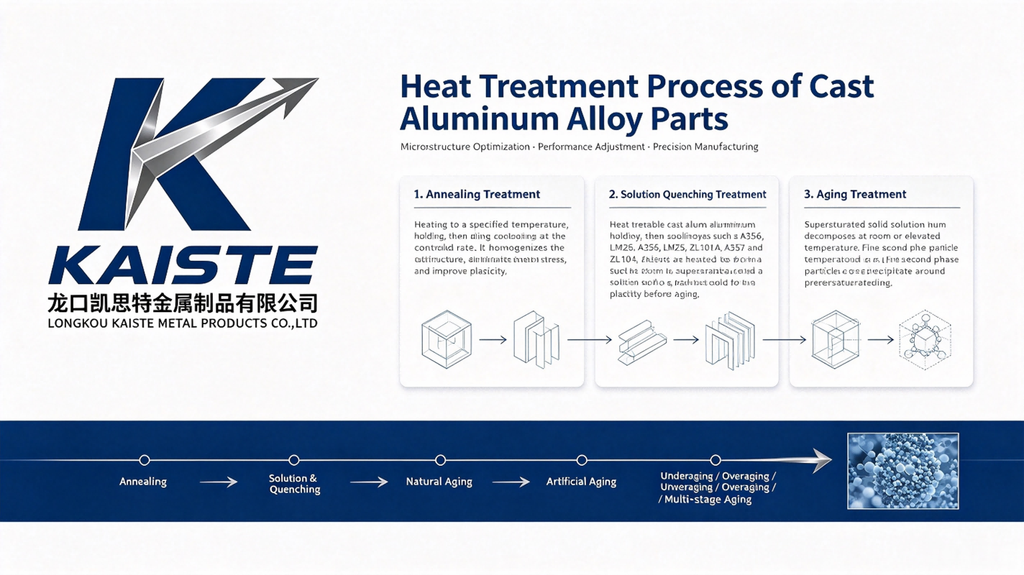
Heat treatment is an essential manufacturing process for gravity-cast aluminum alloy products, which can effectively optimize the internal microstructure, eliminate residual defects, and adjust the mechanical properties of castings. The mainstream heat treatment processes for cast aluminum alloys mainly include annealing, solution quenching, and aging treatment, each with unique working principles and application effects.
1. Annealing Treatment
Annealing refers to the process of heating gravity-cast aluminum alloy products to a specific temperature, maintaining the temperature for a certain period, and then cooling them to room temperature at a controlled speed. During the heating and heat preservation process, the internal atoms of the aluminum alloy diffuse and migrate sufficiently. This structural change makes the internal microstructure of the casting more uniform and stable, and completely eliminates the residual internal stress generated during the casting process. In terms of mechanical properties, annealing can significantly improve the plasticity and toughness of aluminum alloy materials. However, the structural stabilization and stress relief will lead to a corresponding reduction in the strength and hardness of the castings, which is suitable for castings that require subsequent plastic processing and stress relief.
2. Solution Quenching Treatment
Solution quenching is a key pre-treatment process for heat-treatable reinforced cast aluminum alloys, which is widely applied to typical grades such as A356, LM25, ZL101A, A357 and ZL104. The process requires heating the aluminum alloy castings to a relatively high temperature and holding the temperature for an adequate time. Under high temperature conditions, the second phases and various soluble components in the alloy fully dissolve into the aluminum matrix, forming a supersaturated solid solution structure. Afterwards, rapid cooling is adopted to quickly lock this high-energy supersaturated solid solution state at room temperature.
The supersaturated solid solution obtained after quenching is thermodynamically unstable and in a high-energy state, so the solute atoms inside the structure have a tendency to precipitate at any time. At this stage, the aluminum alloy castings have excellent plasticity and low hardness, which creates favorable conditions for subsequent cold working, shape correction and finishing processes of the parts.
3. Aging Treatment
Aging treatment is the core strengthening process for quenched aluminum alloy castings. After solution quenching, the unstable supersaturated solid solution will decompose when the castings are kept at room temperature or elevated temperature for a certain time. A large number of fine second-phase particles precipitate and distribute uniformly around the α-Al grain boundaries. This precipitation behavior significantly improves the strength and hardness of the aluminum alloy, and the strengthening mechanism is defined as precipitation hardening (or age hardening). According to different treatment temperatures and process modes, aging treatment is divided into natural aging and artificial aging.
3.1 Natural Aging
Certain aluminum alloy grades represented by ZL301 can realize spontaneous precipitation and structural strengthening at room temperature without external heating. This room-temperature aging strengthening process is called natural aging, which features simple operation and no thermal damage to castings.
3.2 Artificial Aging
For typical alloys such as A356, the precipitation strengthening effect is extremely weak at room temperature, and effective structural strengthening can only be achieved under elevated temperature conditions. This temperature-assisted aging process is artificial aging, which has controllable process parameters and stable strengthening effects, making it the most widely used aging process for cast aluminum alloys.
To meet different performance requirements of aluminum alloy castings, artificial aging can be further optimized into three process types: underaging, overaging and multi-stage aging. Underaging is carried out at a lower temperature with a shorter holding time to obtain specific targeted mechanical properties. Overaging is implemented at a higher temperature or with prolonged heat preservation time, which can endow the castings with special properties and excellent comprehensive mechanical performance. Multi-stage aging divides the whole aging process into two-stage, three-stage or more staged treatments. By reasonably adjusting the temperature and time of each stage, it can accurately optimize the microstructure and meet the high-precision comprehensive performance requirements of high-end aluminum alloy castings.