
High-Pressure Die Casting vs. Gravity Casting:
Aluminum alloy casting is one of the most widely used manufacturing processes in the automotive, machinery, electronics, and hardware industries. For manufacturers and buyers, choosing between High-Pressure Die Casting (HPDC) and Gravity Die Casting (GDC) directly affects product precision, mechanical performance, production cost, and batch efficiency. This article systematically compares the two mainstream aluminum casting processes to help industry practitioners select the optimal solution for different product requirements.
1. Basic Process Principles
High-Pressure Die Casting (HPDC)
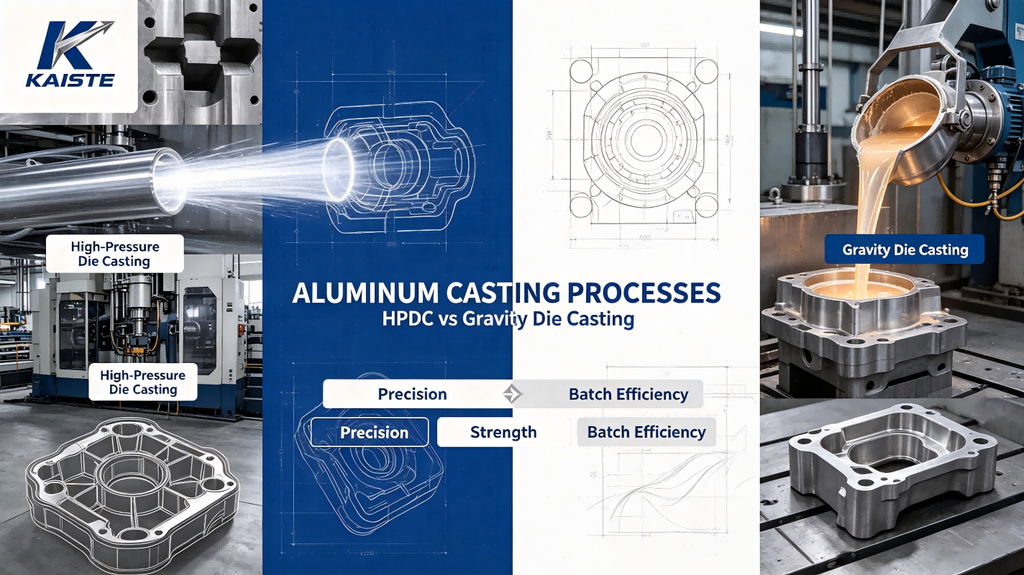
High-pressure die casting is a highly automated precision molding process. Molten aluminum alloy is injected into a high-precision steel mold at an ultra-high speed of 30–60 m/s and extreme pressure of 20–200 MPa. The metal fills the entire mold cavity in milliseconds and solidifies rapidly under sustained pressure. This process relies on professional high-pressure die-casting machines to achieve fast, repetitive, and standardized production, which is the core process for mass production of complex aluminum parts.
Gravity Die Casting (GDC)
Also known as permanent mold casting, gravity die casting is a traditional and stable molding process. It completely depends on the natural gravity of molten aluminum to slowly and evenly fill the preheated reusable metal mold without any external pressure assistance. The molten metal solidifies steadily in the mold, with a mild filling process and no violent turbulence. It features simple operation, flexible production, and low mold wear, suitable for customized and medium-batch production scenarios.
2. Core Differences in Production Performance
Production Efficiency & Batch Adaptability
HPDC boasts outstanding production efficiency, with a single product cycle of only 15–60 seconds. It supports continuous automated production and is perfectly adapted to high-volume mass production of 10,000+ pieces annually, which can greatly shorten delivery cycles and reduce unit labor costs. In contrast, GDC has a slower production rhythm, with a single cycle of 2–10 minutes. It is more suitable for small and medium batch production and customized parts with low delivery urgency, with more flexible production scheduling.
Product Precision & Surface Quality
Benefiting from high-pressure rapid filling and high-precision die design, HPDC products feature ultra-high dimensional accuracy, excellent surface smoothness, and thin-wall molding capability. It can form complex structural parts with fine grooves, holes, and irregular shapes, greatly reducing subsequent machining workload. GDC has relatively conventional dimensional tolerance and surface finish, with limited capability for thin-wall and ultra-complex structures, requiring more manual finishing and CNC precision processing in the later stage.
Internal Quality & Mechanical Properties
Due to the high-speed turbulent filling, HPDC products may produce tiny porosity inside, which slightly limits their airtightness and tensile strength. Such parts are usually used for non-high-load structural components. GDC realizes stable filling and slow solidification, with extremely low internal porosity, dense and uniform metal texture, and excellent overall mechanical strength, airtightness, and toughness. It is the preferred process for thick-wall parts, pressure-bearing parts, and structural components with high load-bearing requirements.
3. Cost & Equipment Investment Differences
HPDC requires high-tonnage die-casting equipment and high-precision customized molds, with high initial tooling and equipment investment. However, its ultra-high production efficiency significantly reduces the single-piece production cost in large batches, showing obvious cost advantages in mass orders. GDC features low equipment and mold investment, low maintenance costs, and flexible early-stage trial production with low trial-error costs. It avoids the waste of high fixed investment caused by small-batch and customized orders, with higher cost-effectiveness in small and medium production batches.
4. Application Scenarios & Selection Suggestions
Choose High-Pressure Die Casting If:
- Products are thin-walled, complex in structure, and require high dimensional precision and surface finish
- Stable large-batch mass production is required to reduce unit cost
- Parts are used for conventional non-pressure-bearing structural components in electronics, household appliances, and general machinery
Choose Gravity Die Casting If:
- Products are thick-walled, simple in structure, and require high density, airtightness, and mechanical toughness
- Small-batch customization, prototype trial production, or medium-batch stable production is needed
- Parts are used for high-load, pressure-bearing, and high-reliability scenarios such as automotive structural parts and mechanical pump bodies
5. Comprehensive Advantages of Kaiste’s Dual-Process Production
As a professional aluminum and zinc alloy casting manufacturer certified with GB/T 19001-2016 / ISO 9001:2015 quality management system, Longkou Kaiste Metal Products Co., Ltd. owns complete HPDC and GDC production lines. We are equipped with 160T–1250T high-pressure die-casting machines, professional gravity casting equipment, and supporting CNC machining and high-precision testing instruments.
We flexibly match the optimal casting process according to customers’ product structure, performance requirements, and order volume. While adhering to eco-friendly and energy-saving production standards, we provide one-stop services from mold development, casting production, precision machining to surface treatment and assembly. Strict quality control throughout the whole process ensures stable and reliable product quality for global customers.
Conclusion
There is no absolute advantage or disadvantage between high-pressure die casting and gravity die casting—only the most suitable process for specific product demands. HPDC focuses on high efficiency, high precision, and mass production, while GDC focuses on high strength, high density, and flexible customization. Mastering the characteristics of the two processes helps enterprises optimize product design, control production costs, and improve product market competitiveness.