
Surface Treatment Processes for Aluminum Die‑Cast Parts
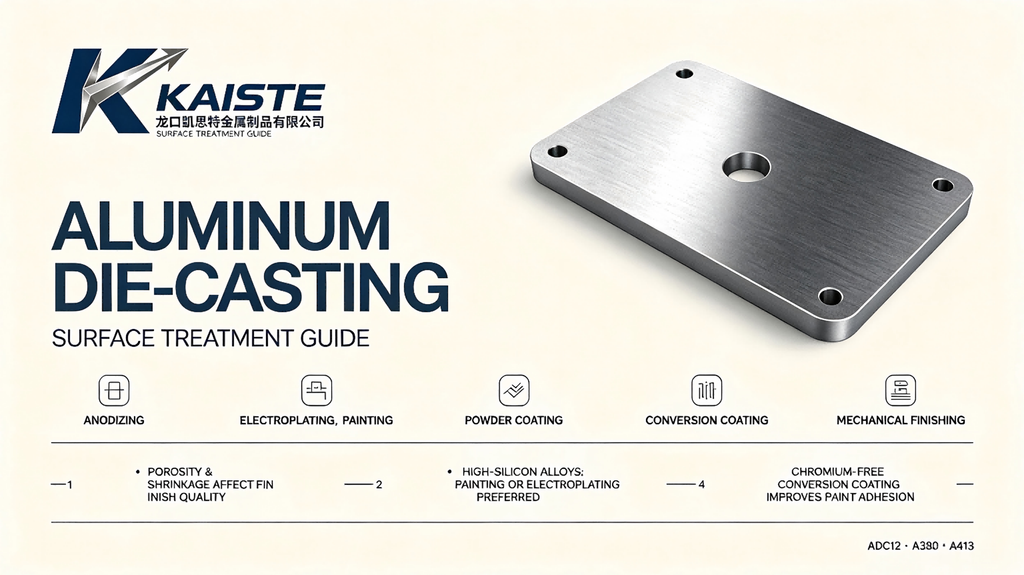
Aluminum die‑cast alloys (ADC12, A380, A413, etc.) are categorized by functions: corrosion protection, decorative appearance, wear resistance, electrical conductivity, and pretreatment for bonding. Die‑cast aluminum contains silicon; some processes are sensitive to porosity and shrinkage defects.
1. Anodizing
Note: High‑silicon die‑cast aluminum delivers poor anodizing performance. High silicon content causes black spots and color inconsistency. This process works better for low‑silicon die‑cast grades and is ideal for wrought aluminum / pure aluminum.
- Sulfuric acid anodizing: Forms porous aluminum oxide film, available in black, silver, gold and other dyed colors. It offers good wear and corrosion resistance. Die‑cast parts tend to produce spots and color variation.
- Hard anodizing: Thick film with high hardness and excellent wear resistance, mainly for mechanical components. Not recommended for die‑cast aluminum, as local burning may occur.
- Natural‑color anodizing: No dyeing, retains original metallic look.
Drawback: Porosity in die‑cast parts may lead to blistering and hole bursting after anodizing. Polishing is required before anodizing; parts with large pores are unsuitable.
2. Electroplating
Electroplating on aluminum die‑cast parts is technically challenging. Aluminum is highly reactive, so zinc immersion (zinc displacement) is mandatory as the base layer.
- Process flow: Degreasing → alkaline etching → zinc immersion → pre‑copper plating → semi‑bright nickel → bright nickel → chrome plating
- Finishing: Bright mirror‑like chrome plating for decorative hardware and auto trims.
- Risks: Die‑casting porosity may cause blistering and peeling. Porosity defects greatly reduce production yield.
- Applications: Automotive decorative parts, sanitary ware, hardware accessories.
3. Painting & Powder Coating
The most widely adopted solution for aluminum die‑castings. It tolerates porosity far better than anodizing and electroplating.
- Liquid painting (liquid coating) Primer + base coat + clear topcoat. Supports gloss, matte and metallic finishes in diverse colors. Epoxy primer and PU topcoat are commonly used.
- Powder coating (electrostatic powder coating) Cured powder film, good weather resistance and wear resistance with moderate cost. Widely used for outdoor products.
Recommendation: Apply chromate / zirconium conversion coating as substrate pretreatment to improve paint adhesion.
4. Chemical Conversion Coating (Pretreatment)
Not for final decorative finish. Mainly serves as primer before painting and temporary corrosion protection.
- Chromate conversion coating: Traditional process with good corrosion resistance, presenting yellow or iridescent appearance. Contains hexavalent chromium and is restricted under RoHS regulations.
- Chromium‑free conversion coating (zirconium / titanium‑based): Current eco‑friendly alternative, colorless or light blue. Used for paint adhesion promotion.
It is only a pretreatment and cannot be used as finished surface.
5. Mechanical Surface Finishing
- Mechanical polishing: Buff polishing for mirror finish. Can be followed by anodizing, electroplating or painting. Porosity on die‑cast surfaces will be exposed after polishing.
- Vibratory tumbling / barrel finishing: Deburring and chamfering, producing uniform matte surface for mass‑produced small components.
- Sand blasting (dry / wet blasting): Creates matte sand‑blast texture and removes die‑casting flow marks. Can be combined with anodizing or painting.
Sand blasting can mask minor casting defects but cannot cover large pores.
6. Other Special Processes
- Electrophoretic coating: Applied after anodizing. Rich color options and great weather resistance. Not ideal for high‑silicon die‑cast aluminum.
- Micro‑Arc Oxidation (MAO): Ceramic‑like film with ultra‑high hardness, outstanding wear and corrosion resistance. High cost; porosity causes local defects on die‑cast parts.
- Passivation: Chromium‑free passivation for temporary rust protection during storage.
- Dip painting / dip coating: Simple protective treatment, rarely used nowadays.
Selection Reference Table for Die‑Cast Aluminum
表格
| Process | Appearance | Corrosion Resistance | Suitability for Die‑Casting | Remarks |
|---|---|---|---|---|
| Anodizing | Metallic texture, dyeable | Excellent | ⚠️Poor for high‑silicon die‑cast alloys | Risk of blistering from porosity |
| Electroplating (Chrome plating) | Bright mirror finish | Good | ✅Feasible, high porosity requirement | Zinc‑immersion pretreatment, unstable yield |
| Powder Coating | Matte / gloss, custom colors | Very good | ✅Best fit for die‑cast parts | Requires conversion coating primer |
| Liquid Paint | Wide color range, metallic effect | Good | ✅Most commonly used | Preferred for cosmetic parts |
| Micro‑Arc Oxidation | Dark grey ceramic texture | Superior | ⚠️Porosity‑sensitive | High cost |
| Sand‑blast + Painting | Matte sand‑blast texture | Good | ✅Mass‑produced cosmetic parts | Hides minor flow marks |
| Chromate / Chromium‑free Conversion Coating | Pale yellow / colorless | Fair | ✅Pretreatment only | Cannot serve as final finish |
Key Notes for Aluminum Die‑Casting Surface Treatment
- Porosity and shrinkage are the biggest risks: Anodizing, electroplating and micro‑arc oxidation are highly sensitive to pores, which will result in blistering and peeling. Painting is more tolerant.
- For high‑silicon alloy ADC12: Anodizing is not recommended, as it causes black discoloration and color difference. Painting or electroplating are preferred.
- Conversion coating (chromium‑free) is strongly recommended for all painted parts to boost coating adhesion.